The most popular advice about AI UGC ads is also the least useful: generate more videos, make them look authentic, and watch conversions rise. That skips the hard part. A synthetic presenter can earn attention without earning trust, and a high-engagement ad can still fail to sell.
Treat AI UGC as a creative production and testing layer, not a performance guarantee or a substitute for every real creator. It can help you explore hooks, formats, and audience variations quickly. Whether any of those variations convert depends on the product, the claim, the execution, and the viewer's confidence in what they're seeing.
Table of Contents
- Why AI UGC Ads Need a Reality Check
- What AI UGC Ads Actually Are
- The Production Workflow From Brief to Render
- How AI UGC Compares With Human Creator UGC
- Disclosure, Trust, and Compliance for Synthetic Creators
- Matching AI UGC to the Right Funnel Stage and Category
- Tools Worth Considering and the Pitfalls to Avoid
- Questions Buyers Ask Before Adopting AI UGC
Why AI UGC Ads Need a Reality Check
AI UGC doesn't automatically outperform human creator content. In a 2023 Oxford Saïd Business School study of real and synthetic models in advertisements, researchers found no detectable difference in ad attitude, brand attitude, industry attitude, or perceived intrusiveness. Adding an AI or synthetic-model disclosure, however, produced a slight decline in ad attitude.
That's a useful result, but it isn't proof that synthetic creators convert as well as real people in every campaign. It measures responses to specific advertising, not universal performance across products, audiences, or funnel stages. And a slight change in ad attitude is still a reason to test disclosure treatment rather than assume it has no effect.
The bigger trap is treating engagement as a synonym for purchase intent. A viewer might pause because an avatar looks odd, watch to see whether the voice matches the face, or comment that the video seems fake. Those reactions may inflate attention while doing nothing for sales.
My rule: Use synthetic creative to test the message and format. Don't treat a convincing render as evidence that customers believe the endorsement.
AI can make it easier to produce variations of a proven concept. It can't supply a real customer's experience, repair an unsupported product claim, or make a weak offer compelling. If your campaign needs authentic social proof, a real customer or creator may be the better asset.
The case for AI UGC is practical, not magical: faster creative iteration and more options to test. Judge it by downstream results, and keep trust, disclosure, and product fit in the same conversation as production speed.
What AI UGC Ads Actually Are
AI UGC ads are paid videos made with AI, or real footage enhanced with AI, to resemble casual creator-style content. They often use vertical framing, direct-to-camera delivery, captions, product visuals, and an informal script. You'll see them in social feeds and short-form video placements, but the label covers several different production methods.
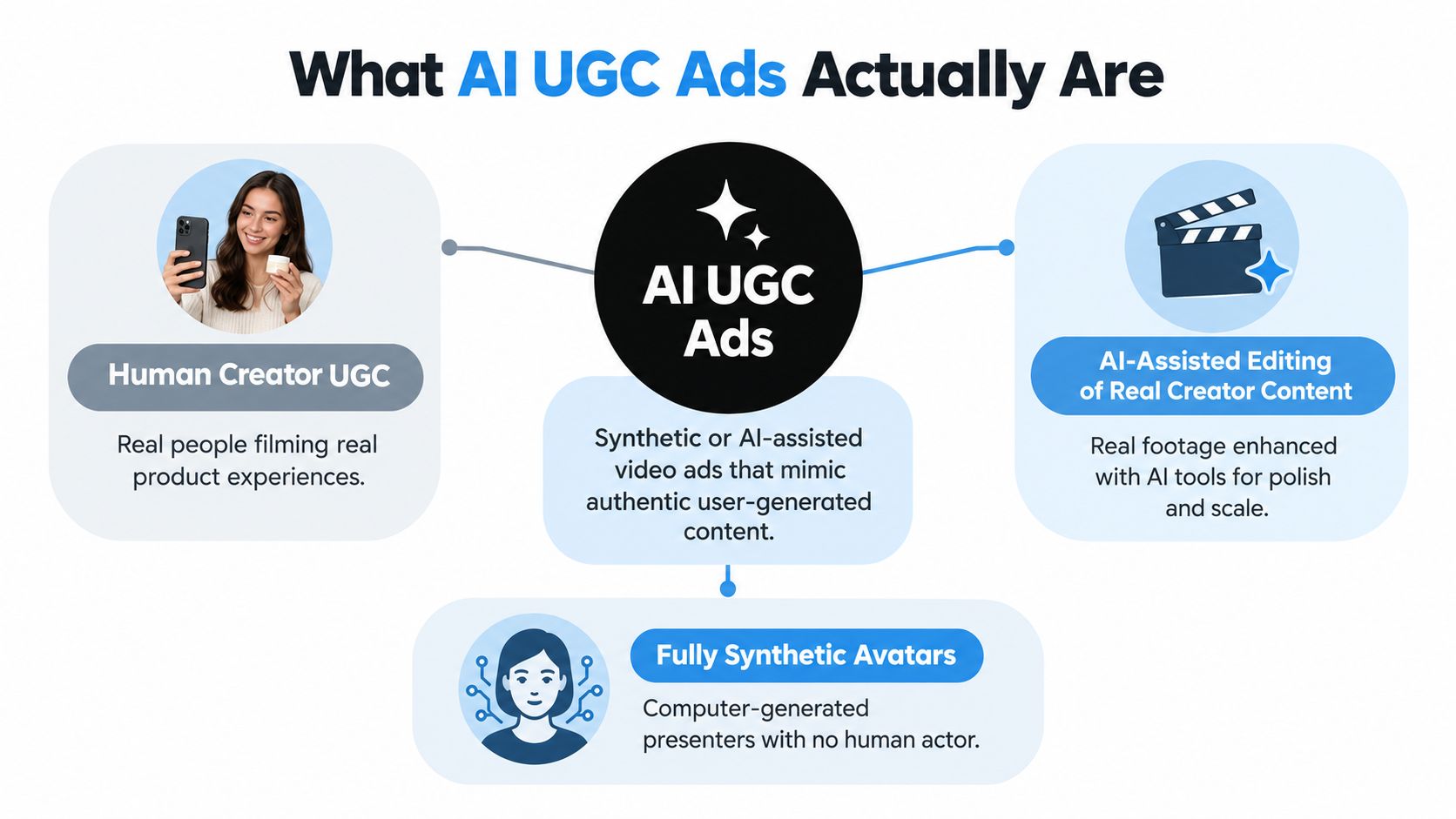
The distinctions matter because a real creator's edited footage carries a different implied identity from a fully synthetic spokesperson.
- Human creator UGC features a real person filming a real product experience. AI might help with captions or editing, but the person and their account of the experience are genuine.
- AI-assisted editing starts with a real creator or customer. Software may generate captions, translate speech, clean up audio, or create alternate edits. If changes alter what the person appears to say or do, review the result carefully.
- Fully synthetic presenter uses a generated face, voice, or both. The person on screen may not exist, and any apparent personal experience needs particular scrutiny.
A finished ad can combine several parts: an avatar or real face, a recorded or synthesized voice, a script, captions, product footage, and B-roll. Don't assume every element is AI-generated just because the video has an AI presenter.
For example, a product brief might become several scripts with different opening lines, each paired with the same synthetic presenter and product shots. That creates useful creative variations, but it doesn't create multiple real testimonials. The scripts are advertising copy, not independent customer accounts.
AI video production is moving into routine campaign planning. In July 2025, the Interactive Advertising Bureau reported that 86% of digital video ad buyers were using or planning to use generative AI for video creative. Buyers also expected generative-AI creative to account for 40% of all advertisements by 2026, a projection rather than a result. Adoption signals production interest, not guaranteed performance.
The Production Workflow From Brief to Render
Start with the offer, not the avatar. If the product benefit is unclear or the claim can't be substantiated, a polished synthetic presenter only makes a weak ad look more finished.
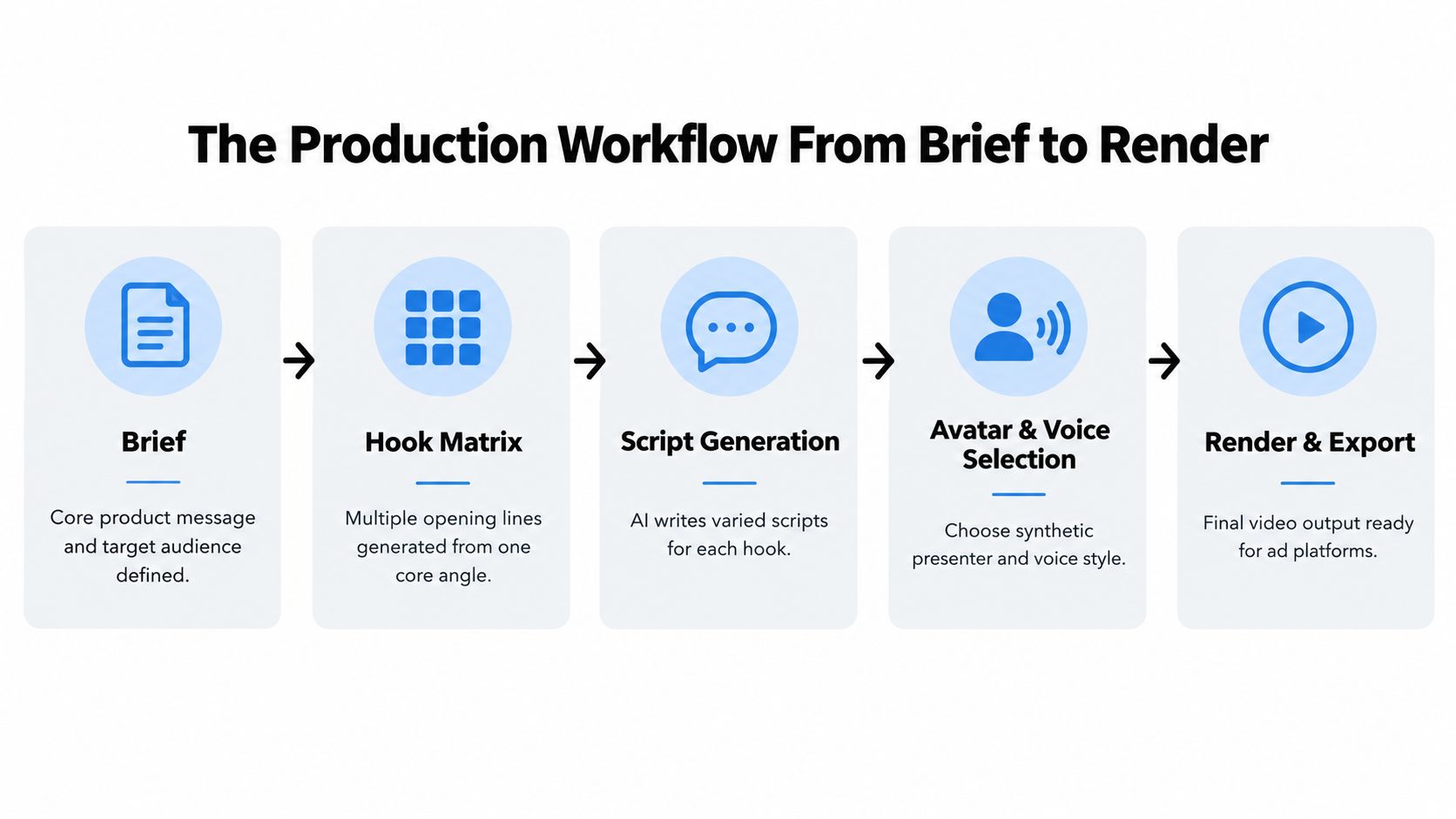
Brief and hook matrix
Write down the audience, product, offer, and one defensible core benefit. Then build a hook matrix around different ways to introduce that benefit: a problem, a product demonstration, a question, or a specific use case. Keep the underlying promise consistent. If each version makes a different claim, you're no longer testing only the hook.
AI can help generate script variants, but don't approve them on volume alone. A generic opening like “You need to try this” could introduce almost any product. Replace it with a specific situation the target buyer recognizes, and remove claims you can't support.
Presenter, voice, and edit
Choose a presenter and voice that fit the audience and the message. Review pronunciation, pacing, expression, lip sync, and facial framing. A face that's too small, poorly lit, or visibly out of sync can make the whole ad feel artificial before the pitch begins.
One large-scale analysis of AI and human-made ads examined more than 500 million impressions and 3 million clicks. It reported that performance depended strongly on perceived authenticity, and identified a large, clear human face as one of the strongest performance signals. That's a reason to inspect framing and realism closely, not a promise that a face will rescue weak creative.
Automate repetitive production work, such as generating alternate scripts, captions, and edits. Keep human review for claims, visual plausibility, brand fit, and disclosures.
A render isn't ready because it plays. It's ready when the words, face, voice, product footage, and disclosure all tell the same honest story.
Before exporting, watch the ad as a viewer would. Check that captions match the audio, product shots represent the item accurately, and the opening doesn't create a misleading impression. Then test the finished variants as ads rather than assuming the most natural-looking version will win.
How AI UGC Compares With Human Creator UGC
AI UGC gives marketers more control over production and iteration. You can revise a script, change the visual treatment, and produce variations without arranging another shoot. That makes it useful for testing creative concepts. It does not give a synthetic presenter the lived experience or credibility of a real creator.
Human creators bring a real voice and personal experience when their endorsement is genuine. Studio creative offers deliberate direction, lighting, and polish. Each format has strengths, and the right choice depends on what the ad needs to prove.
| Dimension | AI UGC Ads | Human Creator UGC | Studio Creative |
|---|---|---|---|
| Authenticity | Can look casual, but the presenter or claimed experience may be synthetic | Comes from a real person; credibility depends on the creator and the truth of the endorsement | Clearly brand-produced, without presenting itself as an informal personal account |
| Production and revisions | Scripts and variations are easy to revise within the tool's capabilities | Requires creator coordination; significant changes may need new filming | Allows hands-on direction, though changes can require more production work |
| Scalability | Supports multiple versions built from one concept | Depends on creator availability and production arrangements | Can scale through a repeatable process, with planning to match |
| Best fit | Testing hooks and formats, product explainers, and concepts that don't depend on personal testimony | Genuine product experiences and endorsements built on personal credibility | Carefully controlled brand stories that benefit from crafted visuals and direction |
| Conversion confidence | Requires validation by audience, offer, and category; realistic visuals alone prove nothing | Offers real experience, but still needs a strong offer and clear message | Delivers a polished brand message, but polish alone does not establish trust |
Separate attention from persuasion. Views and comments show whether an ad earns a reaction. They do not establish that viewers believe its claims or intend to buy. Track engagement, sentiment, and conversion as distinct outcomes.
A study comparing AI ad styles found that UGC-style AI ads tended to generate stronger engagement, while marketer-generated AI ads produced more positive sentiment. Treat that finding as a reason to measure engagement and sentiment separately, not as a universal winner or evidence of purchase performance.
Match the format to the claim the ad needs to make. Use AI to test messages and creative treatments when the idea does not rely on a real person's experience. Choose a real creator when actual use, opinion, or personal credibility carries the argument. Use studio production when careful control and crafted presentation matter more than a casual creator aesthetic. Judge each format by the job it performs, then test conversion rather than assuming that attention will turn into sales.
Disclosure, Trust, and Compliance for Synthetic Creators
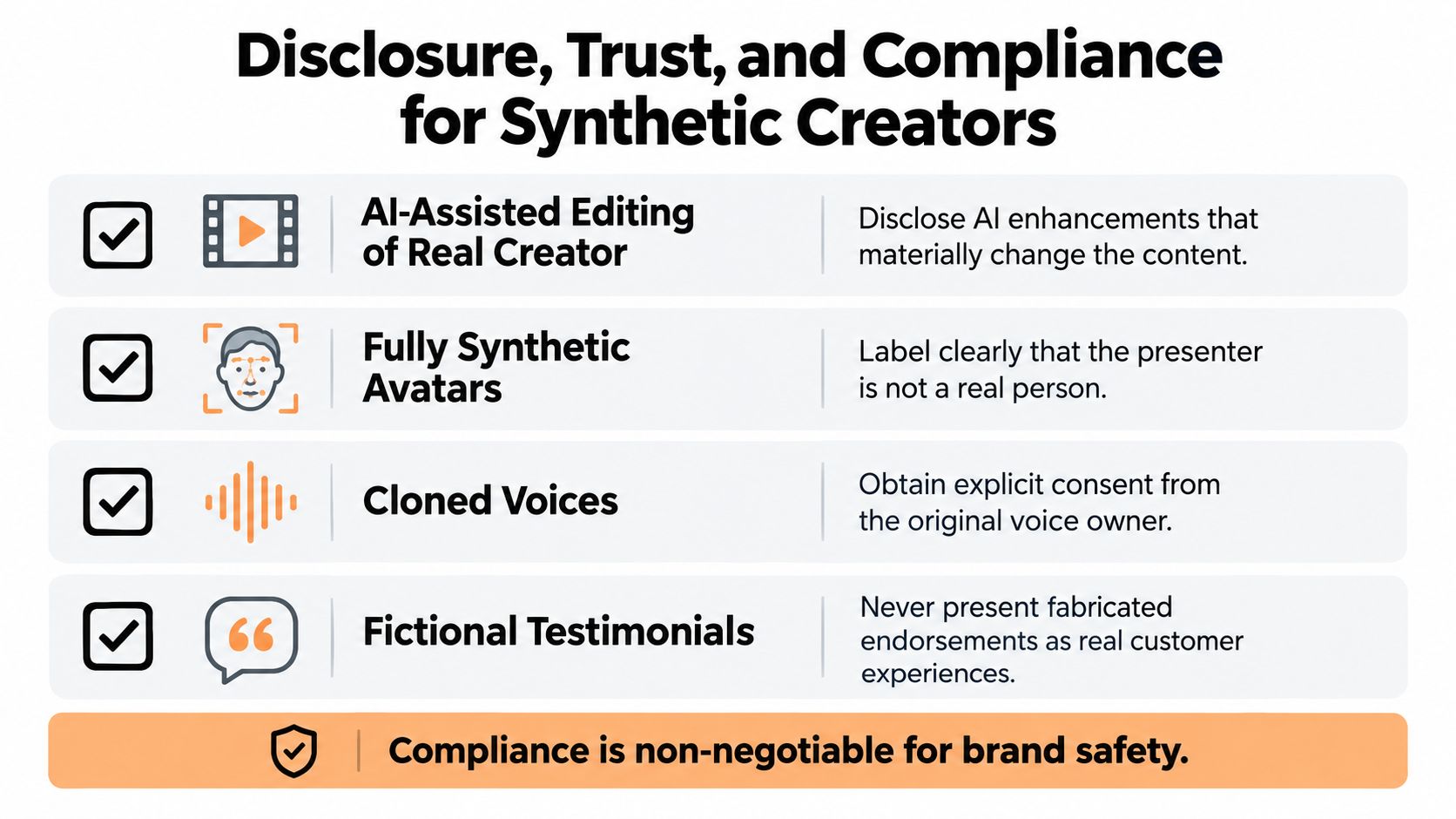
Treat each kind of AI involvement as a distinct disclosure question. Editing real footage, generating a presenter, synthesizing a voice, and inventing a testimonial carry different risks. The governing test is simple: could viewers mistake the synthetic person for a real customer, creator, expert, or independent endorser?
The legal commentary on influencer marketing and synthetic performers explains that FTC endorsement principles apply to virtual endorsers as well as human endorsers. Disclose material connections clearly and conspicuously, and substantiate objective product claims.
Match the disclosure to the content
An “AI-generated” label can identify a synthetic presenter; it cannot make a fictional product experience true. If a script says, “I used this and it fixed my problem,” viewers can reasonably take it as a real person's account. Don't give a synthetic spokesperson that claim as though the experience happened.
For creator footage altered with AI, disclose material changes when they could alter what viewers understand the creator to have said or done. Get consent from the voice owner before using a cloned voice. If a fully synthetic presenter could be mistaken for a real customer or independent expert, make that distinction clear.
Disclosure does not erase the trust cost of a synthetic presentation. As noted earlier, labeling and creative choices can affect audience responses. Don't treat a label as a way to disguise artificial authorship, and test clear, honest disclosure rather than implying a human endorsement that does not exist.
Review every market and placement
No single label settles every legal, platform, and audience concern. Check the requirements in each market where the ad will run, including rules that apply to synthetic performers or AI likenesses. An on-screen notice may not be enough in every placement. Where practical, use both visible and audible disclosure so the message is clear across viewing contexts.
Before launch, review these points:
- Identity: Could viewers mistake the presenter for a real customer, creator, or expert?
- Experience: Does the script claim a personal experience that never happened?
- Claims: Can you substantiate every product statement?
- Placement: Is the disclosure easy to notice and understand in this format?
- Market: Have you checked relevant platform and local requirements, including rules that may apply to New York audiences?
A label alone does not protect trust. The ad must also avoid suggesting a real endorsement or experience that does not exist.
Matching AI UGC to the Right Funnel Stage and Category
There's no sensible blanket rule that synthetic UGC is either a win or a failure. Decide where to test it based on what the viewer needs to believe before taking the next step.
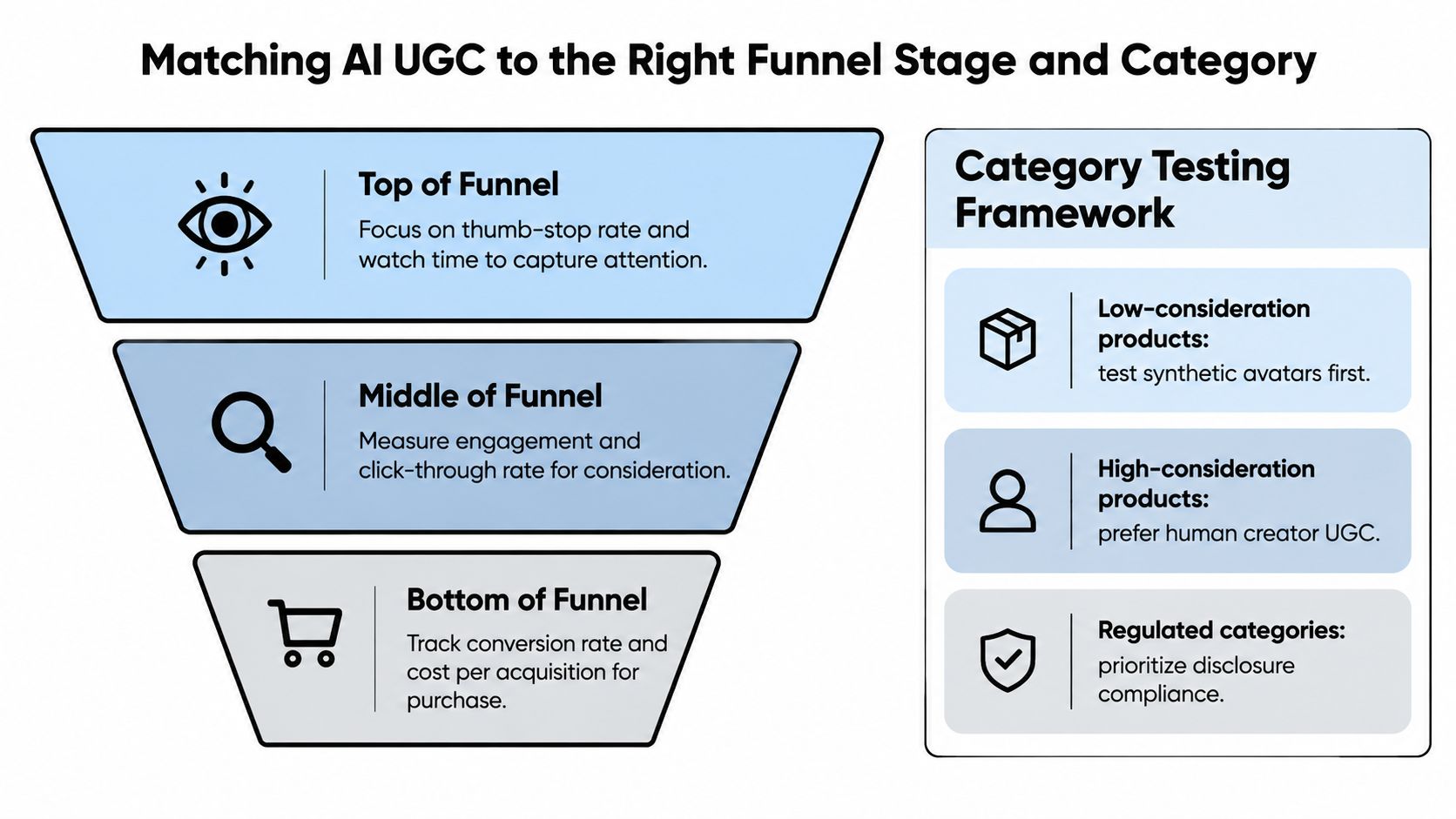
At the top of the funnel, test whether the opening earns attention. Track thumb-stop rate and watch time. A strong result there means people stopped and watched, not necessarily that they're persuaded.
For consideration, look at comments, click-through rate, and whether the ad gives viewers a useful reason to investigate further. Read comments for confusion or skepticism as well as enthusiasm. A high click-through rate can still send people to a landing page that fails to answer their questions.
At the purchase stage, evaluate conversion rate and refund rate, along with the cost of acquiring a customer. Check brand sentiment too, especially if viewers object to a synthetic presenter or feel a testimonial is misleading. Don't let an attention metric stand in for a sales result.
Make the category part of the test
For a low-consideration product, a synthetic presenter may be a reasonable early creative to test if the ad demonstrates the item clearly and makes no false personal claims. For a complex or expensive purchase, buyers may need credible explanations and reassurance that go beyond a creator-style script.
Be more cautious with health, finance, and other regulated categories. Claims may carry higher stakes, and a synthetic spokesperson can make an unsupported or misleading promise feel like advice from an expert. Have qualified reviewers check the claims and disclosures before launch.
Decision rule: If the sale depends on “I tried this myself,” use a real person who actually did. If the sale depends on clear product information, test whether AI can deliver it without confusing or misleading the viewer.
Run separate tests by funnel stage and product category. A synthetic ad that earns attention may still be the wrong choice for a trust-heavy claim. Judge the format on the result you need, not the metric that's easiest to celebrate.
Tools Worth Considering and the Pitfalls to Avoid
Pick tools by task, not by the size of a feature list. A workable stack needs a way to draft scripts, produce or edit video, handle captions and voice, and review the finished ads. If one platform covers several jobs well enough, that may be simpler than stitching together a collection of specialist apps.
For synthetic presenters and voice, compare services such as HeyGen and Captions based on the realism, consent controls, and editing options your campaign needs. For scripting and hook development, use a writing assistant to produce alternatives, then have a marketer check that each one reflects the actual offer and customer language. Use an editor such as CapCut or Descript when you need hands-on caption, pacing, or audio cleanup.
If you want to compare tools before choosing a workflow, Revid Reviews collects public reviews of Revid from platforms including Product Hunt. Revid.ai is another option for creating short-form videos from product or landing-page URLs, with features for generating scripts, voiceovers, captions, scenes, and audio.
Keep the stack reviewable
A tool that generates a video quickly can still create work downstream if you can't inspect its source elements or control its output. Check what it lets your team review and revise: scripts, voices, captions, avatar choices, product footage, exports, and disclosure placement. Confirm that you have permission to use any voice, likeness, or source content.
Operational maturity matters too. The IAB's 2025 State of Data report found that only 30% of agencies, brands, and publishers had fully integrated AI across media planning, activation, and analysis. Nearly two-thirds identified data quality, data protection, and fragmented tools as leading barriers. That's a warning against treating creative generation as a complete advertising system. Measurement, privacy, approvals, and campaign operations still need owners.
The failures are predictable: avatars with unnatural expressions, scripts that sound like product copy, generic hooks, missing disclosures, and claims that no one checked. A tool can multiply those mistakes as easily as it can multiply good ideas.
Keep the first workflow small and auditable. Generate a few different creative directions, review each one for authenticity and compliance, and connect its results to the right campaign metrics. Add tools or automation only when they solve a specific production or review bottleneck.
Questions Buyers Ask Before Adopting AI UGC
Can a small team use AI UGC?
Yes, if it can review what it publishes. A lean team can use AI to produce and compare creative variations, but it still needs someone responsible for claims, disclosures, and ad performance. Lower production friction doesn't remove those jobs.
Does it work on TikTok and Meta?
It can be tested on either, but don't assume the same creative will perform identically across placements. Follow each platform's current rules, adapt the edit to the placement, and compare results within each campaign.
How often should creative be refreshed?
Refresh when performance weakens, the offer changes, or the audience stops responding. Don't create new versions just to keep a calendar busy. Each variation should test a clear change, such as the hook, presenter, or product demonstration.
How much time will it save a one-person team?
AI can reduce coordination and make script or edit variations easier to produce. The actual saving depends on how much review and revision each ad needs, so measure your own end-to-end workflow rather than relying on a generic promise.
Revid Reviews collects public reviews of Revid from Trustpilot, X, and Product Hunt, with links to the original reviews, and publishes buyer guides about AI video tools. If you're weighing AI UGC production options, visit Revid Reviews to compare practical considerations before choosing a workflow.