Most advice about faceless YouTube videos starts in the wrong place. It treats automation like the product and the channel as an output machine, when YouTube rewards originality, audience activity, and clear editorial value. You can use AI to build a faceless channel, but if the videos feel interchangeable, the format becomes the problem.
YouTube's own rules make that clear. Faceless videos aren't a separate monetization category, and channels still need to qualify under the same Partner Program requirements as everyone else, including the long-standing thresholds of 1,000 subscribers plus either 4,000 valid public watch hours in the previous 12 months or 10 million valid public Shorts views in the previous 90 days, with a smaller access tier for selected fan-funding and shopping features at 500 subscribers, 3 public uploads, and either 3,000 long-form watch hours or 3 million Shorts views in the relevant windows YouTube Partner Program requirements. That's the actual starting point for any faceless channel strategy.
Table of Contents
- The reality of AI automation and inauthentic content
- Choosing a defensible niche and format
- Building a sustainable AI production workflow
- Navigating YouTube Partner Program requirements
- Establishing audience trust without a face
- Launching and auditing your first uploads
The reality of AI automation and inauthentic content
A faceless channel is not automatically safer just because the creator stays off camera. YouTube still evaluates the channel by what it publishes, and narration, stock footage, animation, screen recordings, or synthetic media can all live inside a monetized channel without creating eligibility on their own. What gets creators into trouble is mass-produced, repetitive, template-driven uploads YouTube's July 2025 policy clarification.
AI output becomes a problem when it looks interchangeable
The shift from “repetitious content” to inauthentic content matters because it targets the workflow, not the absence of a face. If every upload is a slight remix of the last one, the channel starts to look like industrial content assembly, even when the visuals are polished. Monetization risk usually starts there.
Practical rule: if a viewer cannot tell why one episode exists instead of five nearly identical siblings, YouTube probably cannot either.
Human contribution separates a channel from a template farm. Original research, fact-checking, script structure, narrative judgment, and editing choices all make the output meaningfully authored. YouTube's policy guidance also says reused content needs significant original commentary, substantive modification, or clear educational or entertainment value, and enforcement can affect the whole channel, not just one upload YouTube's policy guidance.
That is why fully automated faceless channels often underperform even when they publish quickly. Speed is not the moat. Editorial taste is.
The dividing line is editorial intent, not visibility
Faceless channels can work, but the channel has to feel deliberate. A synthetic narrator reading generic summaries over stock clips is fragile. A channel built around original commentary, a distinct angle, and a repeatable editorial standard is much harder to classify as low-value output.
A simple comparison makes the difference obvious. A channel that auto-generates “top facts” videos from the same source stack, same pacing, and same visual template every week is easy to flag as repetitive. A channel that uses AI to draft a script, then adds original commentary, selective sourcing, and a consistent point of view has a clearer editorial footprint. The second one gives reviewers something to evaluate beyond the machinery behind it.
AI can still be part of that workflow, but it cannot replace authorship. YouTube has said AI-assisted channels can still qualify for monetization, and realistic altered or synthetic content may require disclosure. AI-generated personas posing as human experts in sensitive subjects such as health, legal, financial, or political topics will not be allowed to monetize. The practical lesson is simple. Use AI as production support, not as a substitute for judgment.
Choosing a defensible niche and format
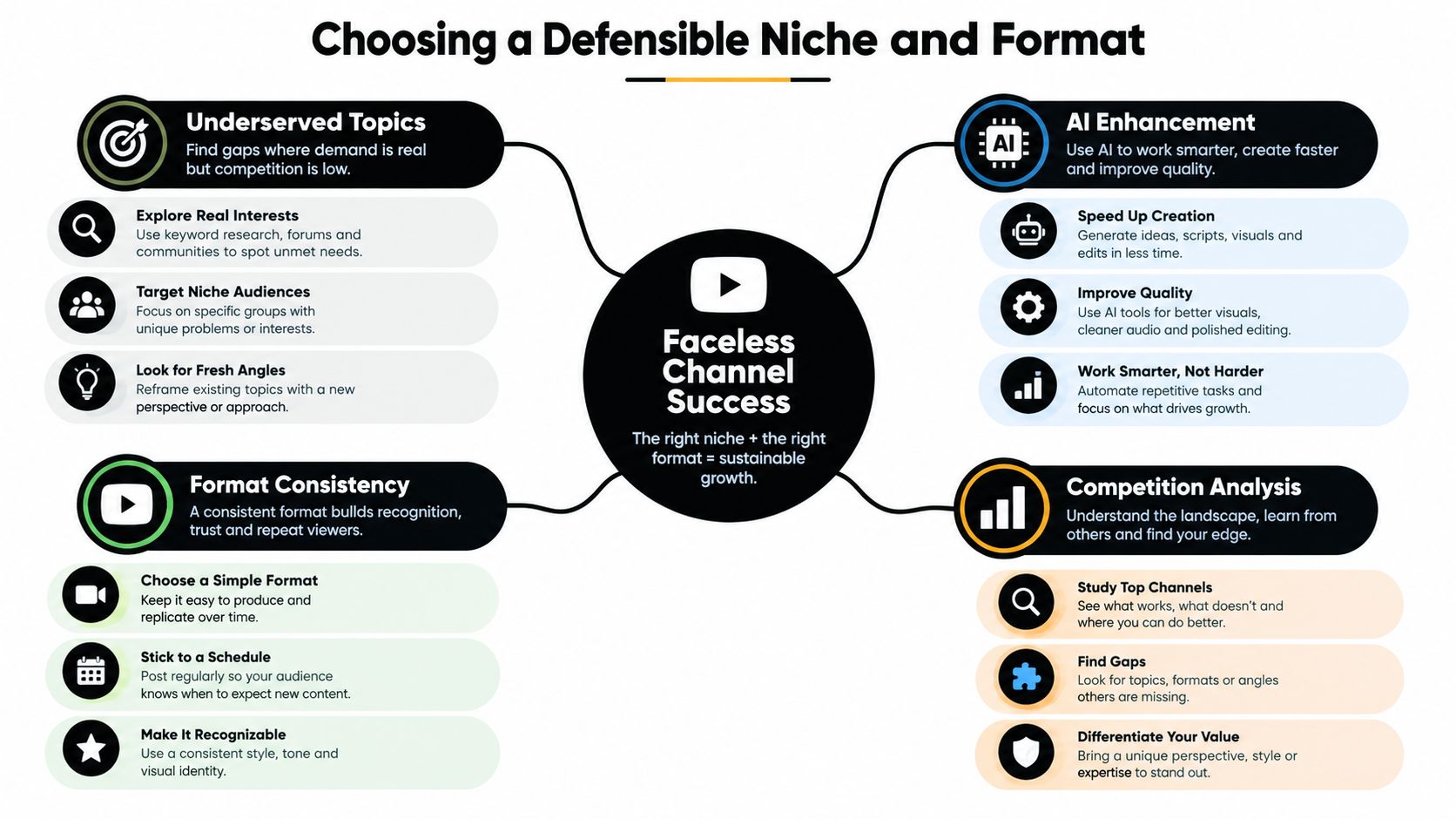
A faceless channel gets easier to grow when the format is narrow enough to be recognized, but broad enough to produce consistently. The temptation is to pick a generic “top 10” lane because it feels flexible. That usually leads to content that blends into everything else in the feed. A better approach is to choose a niche where AI helps you tell the story faster, while your own perspective still shapes the result.
Start with an angle, not a keyword
The strongest faceless channels usually solve one of three problems. They explain something complicated, they retell something compelling, or they organize scattered information into a clear narrative. That's why documentary explainers, narrated case studies, and visual essays tend to age better than disposable listicles.
Pick topics where your channel can have a point of view. If AI can scrape the topic and produce an acceptable script in seconds, you need a sharper angle, better structure, or original sourcing. The niche should let you add judgment, not just assembly.
A practical filter helps here:
- Underserved questions. Look for topics viewers ask but creators answer poorly.
- Visible source material. Choose subjects where you can show evidence, screenshots, documents, or clips.
- Repeatable format. The audience should recognize the structure from video to video.
- Room for commentary. The topic needs enough complexity that your interpretation matters.
Build around a format that can't drift
Faceless channels fail when every upload changes identity. One week it's a voiceover explainer, the next it's a meme recap, then a generic history video. Consistency matters because the audience needs a reason to expect a certain experience from the channel.
The easiest way to stay defensible is to lock the format early. For example, a channel could use narrated timelines, documentary breakdowns, or comparison-style explainers with the same visual grammar every time. That keeps production efficient without making the content feel copy-pasted.
If you're evaluating tools or studying examples before committing, the review library at Revid Reviews is one useful place to compare how different faceless workflows are packaged for creators. The important part is still the same, though. The tool should support the format, not define it.
Building a sustainable AI production workflow
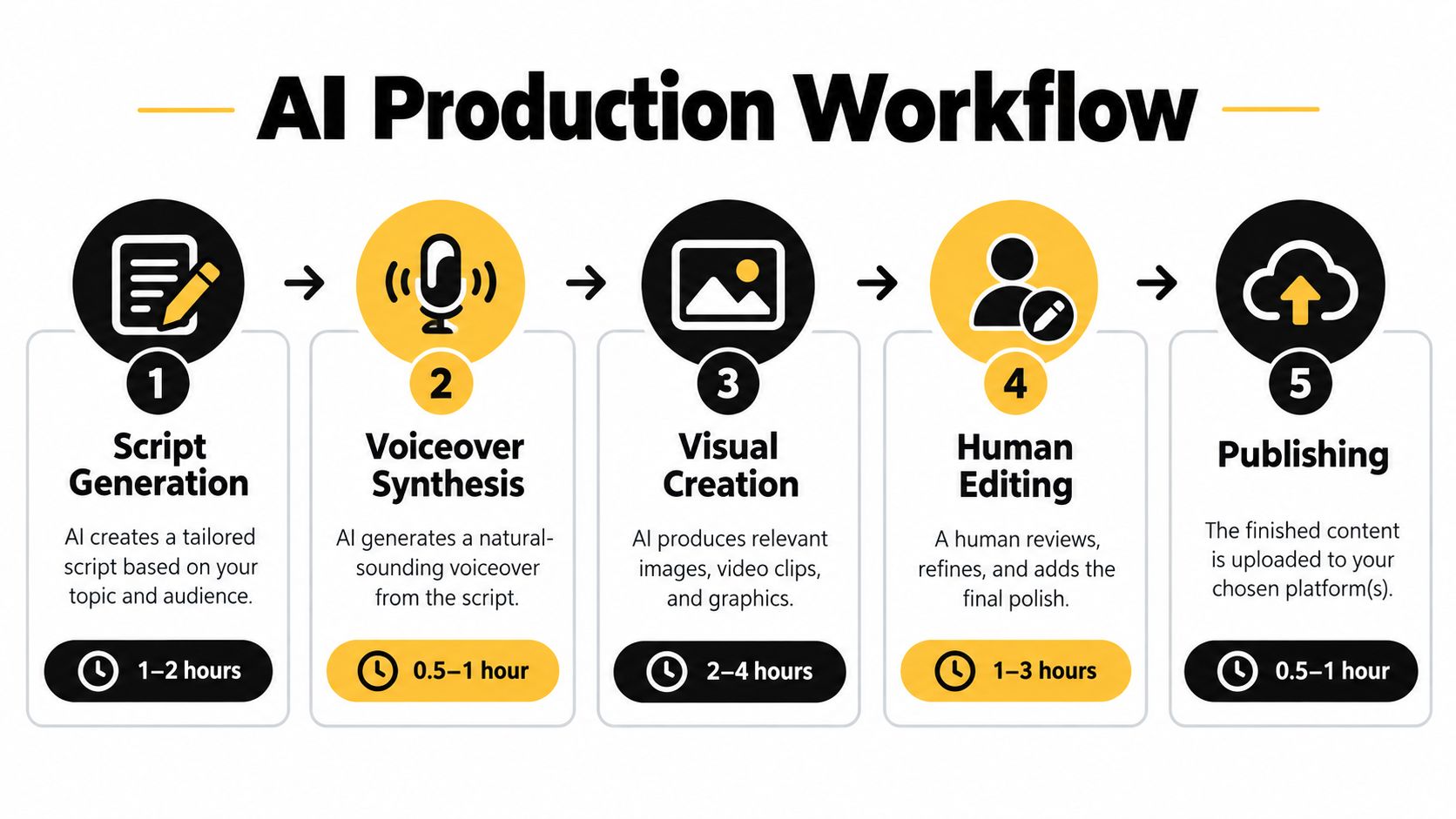
A sustainable faceless workflow cuts repetitive work without stripping out judgment. AI should handle the fast parts, then the creator should step in for accuracy, pacing, and editorial taste. That is what keeps a channel from sounding like every other automated upload.
Use AI for drafts, not final authority
The first draft should move fast. Feed the model the topic, the angle, source notes, and the exact promise of the video. Then rewrite the output until it reads as one voice, not several prompts stitched together. If the script feels like a summary of summaries, the video will feel thin.
Voice generation needs the same discipline. A natural-sounding AI voice still needs pacing control, emphasis, and pauses that fit the story. If a line feels flat on the page, it usually sounds flatter in narration.
Match visuals to narrative beats, not just keywords
Stock clips and generated visuals work when they support the sentence being spoken. They fail when they are chosen only because a keyword matched. That is how you end up with footage that looks related but feels disconnected from the story.
Keep one question in mind while editing, does this shot add information, emotion, or rhythm?
That test matters even more when you mix original reporting with AI-assisted production. It forces the edit toward judgment instead of assembly, and it helps retention because viewers can feel when the visual track is random or lazy.
Build the workflow stack around the story
A practical production stack usually has five parts. Script draft, human rewrite, voice and visuals, editorial review, then publish and monitor. The exact tools can change, but the sequence should not.
For creators comparing tools that turn prompts, URLs, or source material into narrated, captioned videos, the Revid Reviews library is a useful place to check buyer feedback before choosing a workflow. Revid is one of the tools people evaluate for faceless YouTube production, and it fits the same principle. AI can speed up assembly, while the creator still has to steer the story.
Add human checkpoints before export
The final pass should catch three things, factual accuracy, repetitive phrasing, and visual repetition. If the intro and outro sound too similar across uploads, fix that before publishing. If the video keeps recycling the same framing device, change the template.
The goal is a repeatable system that still leaves room for taste. A channel that relies on the same prompts, the same pacing, and the same visual loops will eventually look disposable. A channel with clear editorial checkpoints can scale without losing its voice.
Navigating YouTube Partner Program requirements
Faceless channels do not get a separate monetization track. YouTube still applies the same Partner Program rules, and the channel has to clear them through actual audience response, not through the presence or absence of a host's face YouTube Partner Program requirements.
Short-form and long-form channels do not hit those rules in the same way. A Shorts-heavy faceless channel can rack up views quickly inside the Shorts window, but those views age out faster than long-form watch time, so growth can look strong without helping every monetization path at the same pace. Long-form faceless channels usually build eligibility more slowly, but the watch hours they earn tend to be more durable.
The thresholds still depend on real viewer activity
For creators who want the full advertising tier, YouTube's requirements are still tied to 1,000 subscribers and either 4,000 valid public watch hours in the previous 12 months or 10 million valid public Shorts views in the previous 90 days YouTube Partner Program requirements.
For smaller channels, YouTube also allows earlier access to selected fan-funding and shopping features at 500 subscribers, 3 public uploads in the last 90 days, and either 3,000 long-form watch hours in the last year or 3 million Shorts views in the last 90 days YouTube Partner Program requirements. That matters for faceless creators because a channel can look active on paper while still missing the kind of viewing pattern that opens monetization features.
| Tier | Subscribers | Watch Hours / Shorts Views |
|---|---|---|
| Early access tier | 500 | 3,000 long-form watch hours or 3 million Shorts views |
| Full Partner Program eligibility | 1,000 | 4,000 valid public watch hours or 10 million valid public Shorts views |
Growth is skewed, so outliers can mislead you
A third-party dataset tracking more than 13,000 faceless channels found that the median channel had about 21,900 subscribers, the top 10% exceeded 818,000 subscribers, and more than 40% stayed below 10,000 subscribers faceless channel distribution sample. That spread matters. A few breakout channels can make faceless monetization look easier than it is, while the middle of the market remains much harder to scale.
The practical takeaway is simple. A faceless channel can be efficient to produce and still fail to earn enough consistent viewer activity. The format has to hold attention, bring people back, and keep the viewing pattern strong enough to satisfy the monetization requirements.
Establishing audience trust without a face
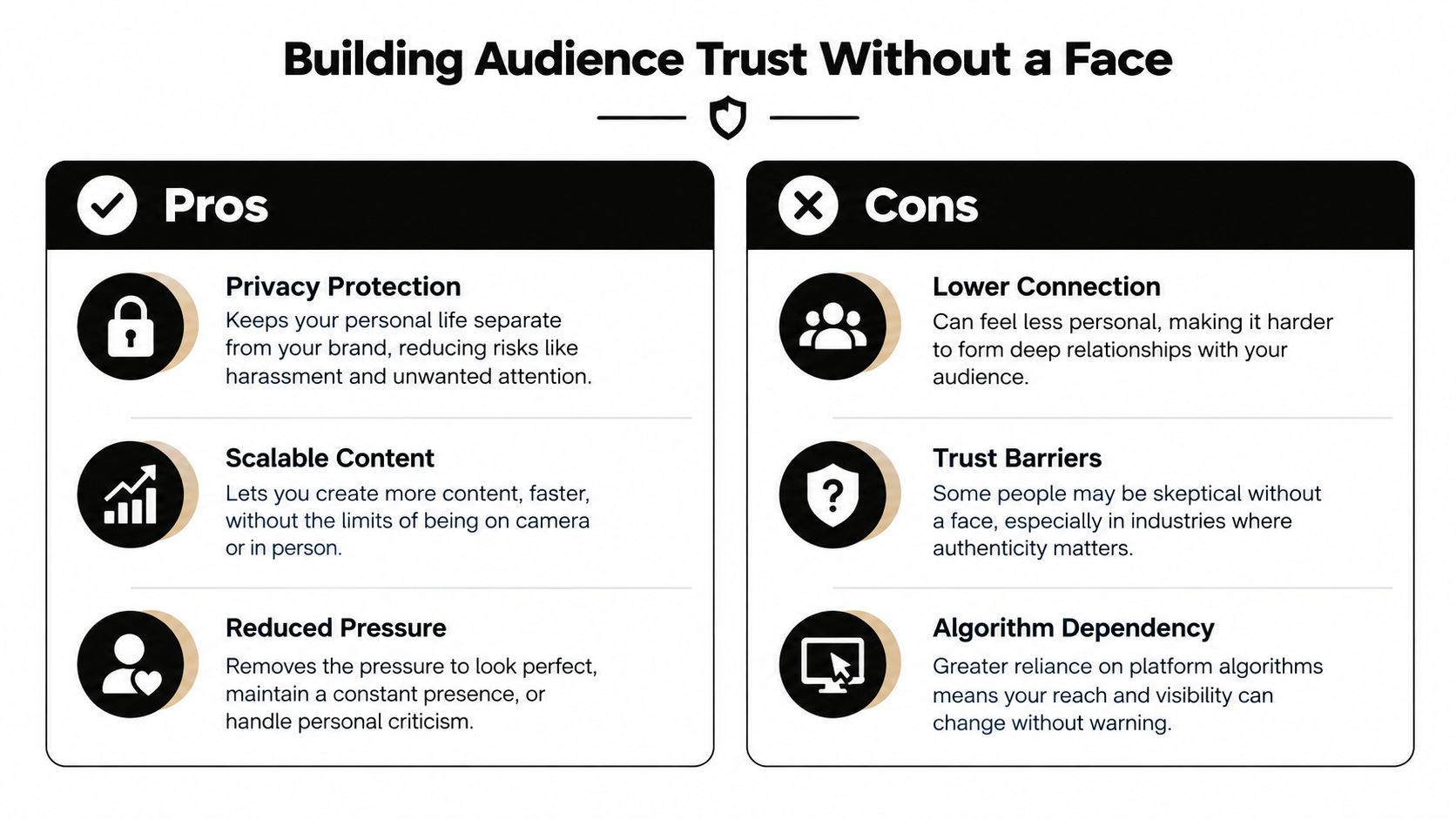
An anonymous channel can work, but anonymity takes away the instant trust cues that a visible host provides. That becomes a bigger deal in niches where viewers want to know who's speaking to them and why they should listen. If you're not using your face, the video has to earn trust through structure, sourcing, and consistency.
Trust has to be visible on screen
The easiest way to build credibility is to make the evidence visible. Show source names, screen captures, document titles, timestamps, or other proof points that make it obvious the script isn't free-floating opinion. In faceless formats, trust is often built by what the viewer can verify while the video plays.
That matters because YouTube's policy is stricter around AI-generated personas presenting themselves as human experts in sensitive fields like health, legal, financial, or political topics YouTube policy on AI and sensitive subjects. If a synthetic host is giving consequential advice, the channel is taking on avoidable risk.
Transparency beats performance
A faceless channel doesn't need to pretend it's a person. It needs to be clear about what it is. If the content uses AI voices, synthetic narration, or altered visuals, disclosure should be easy to find and easy to understand, especially when the presentation could otherwise be mistaken for a real human expert.
Practical rule: don't use a synthetic presenter to borrow authority you haven't earned.
The strongest anonymous channels usually lean into a different promise. They can be documentary-like, source-heavy, or educational without claiming a personal identity they do not have. That's a stronger brand position than vague confidence or fake expertise.
If you're comparing how different creators present trust signals, Revid Reviews is one place to see public feedback tied back to original reviews. The value there isn't hype, it's seeing how a product or workflow is discussed when buyers have to verify claims for themselves.
Launching and auditing your first uploads
The first few uploads should be treated like tests, not proof of concept success. A faceless channel can look polished and still fail if it repeats the same visual beats, overuses synthetic phrasing, or ignores basic disclosure. Early auditing saves you from building a library of videos that all share the same weaknesses.
Check the video like a skeptical viewer would
Before publishing, inspect the upload for repetitive visual patterns, weak transitions, and any sections where the AI voice loses clarity. If the opening scenes all look like the same template, the audience will sense that immediately. If the thumbnail and title promise one thing while the script delivers another, click-through may happen, but satisfaction won't.
Audit for compliance before you scale
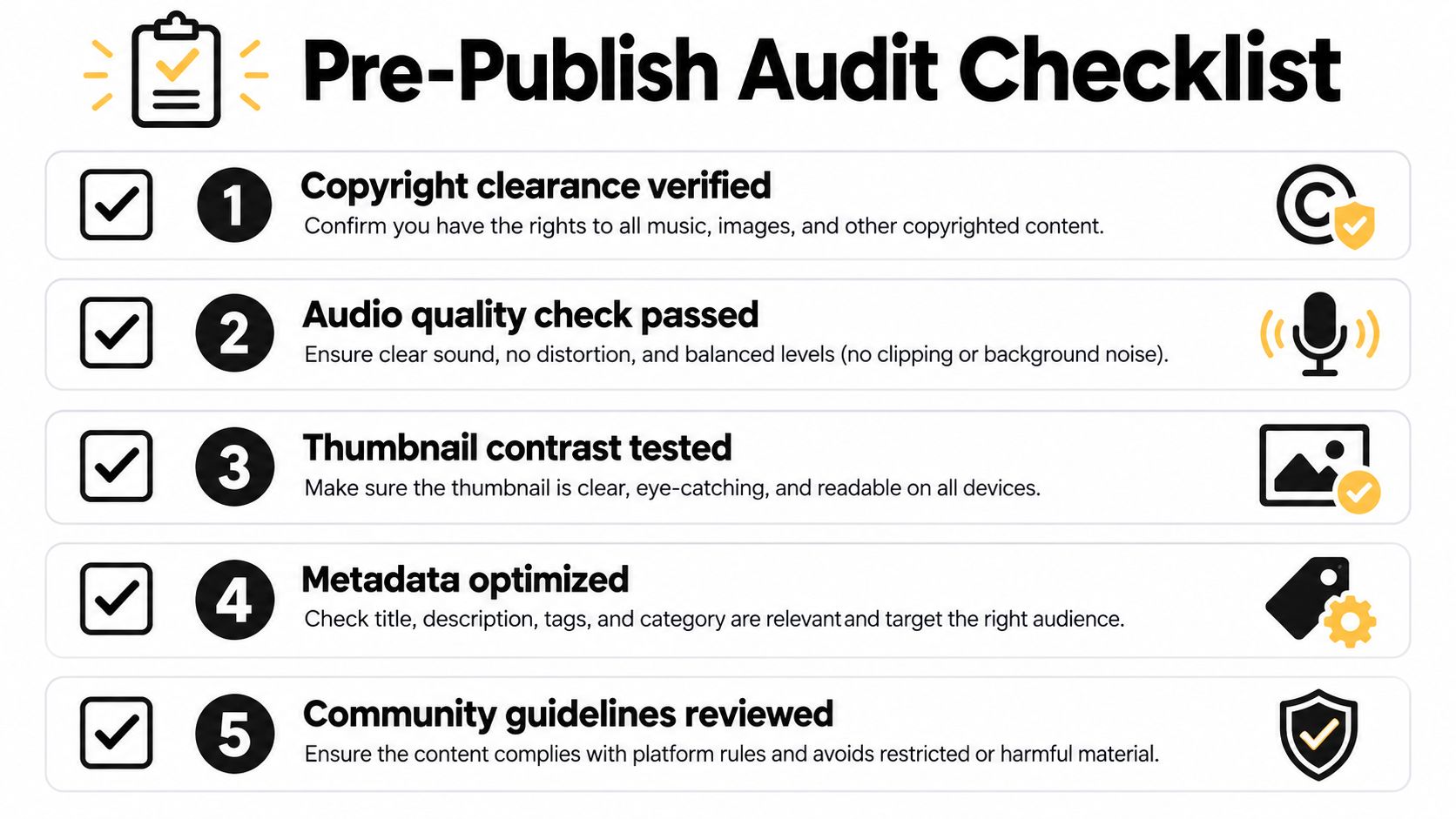
Make sure copyright clearance is understood, audio is clean, thumbnails are readable, metadata is accurate, and community guidelines aren't being brushed aside. If AI involvement needs disclosure, make it obvious. Don't wait for a problem to tell you the video should've been labeled better.
A simple launch checklist works well:
- Copyright clearance verified. Confirm every clip, asset, and music track is usable.
- Audio quality checked. Listen for robotic pacing, clipping, or mismatched levels.
- Thumbnail contrast tested. Make sure the image is legible on a small screen.
- Metadata optimized. Align the title, description, and tags with the actual topic.
- Community guidelines reviewed. Check whether the topic or presentation creates policy risk.
Use the first analytics as editing feedback
Early retention is the most useful signal because it tells you where the format loses people. If viewers drop off at the same point in multiple uploads, the issue is probably structural, not random. Fix the opening, tighten the pacing, or cut visual dead space before making more videos.
If you're comparing tools and distribution options for that first batch of uploads, Revid Reviews collects public response from product communities alongside other review sources. That's useful when you want to compare creator workflows without guessing how buyers talk about them.
If you're building faceless YouTube videos with AI, Revid Reviews helps you compare tools, features, and real buyer feedback before you commit to a workflow. Visit Revid Reviews to see how different AI video approaches fit faceless channels, from script generation to publishing.